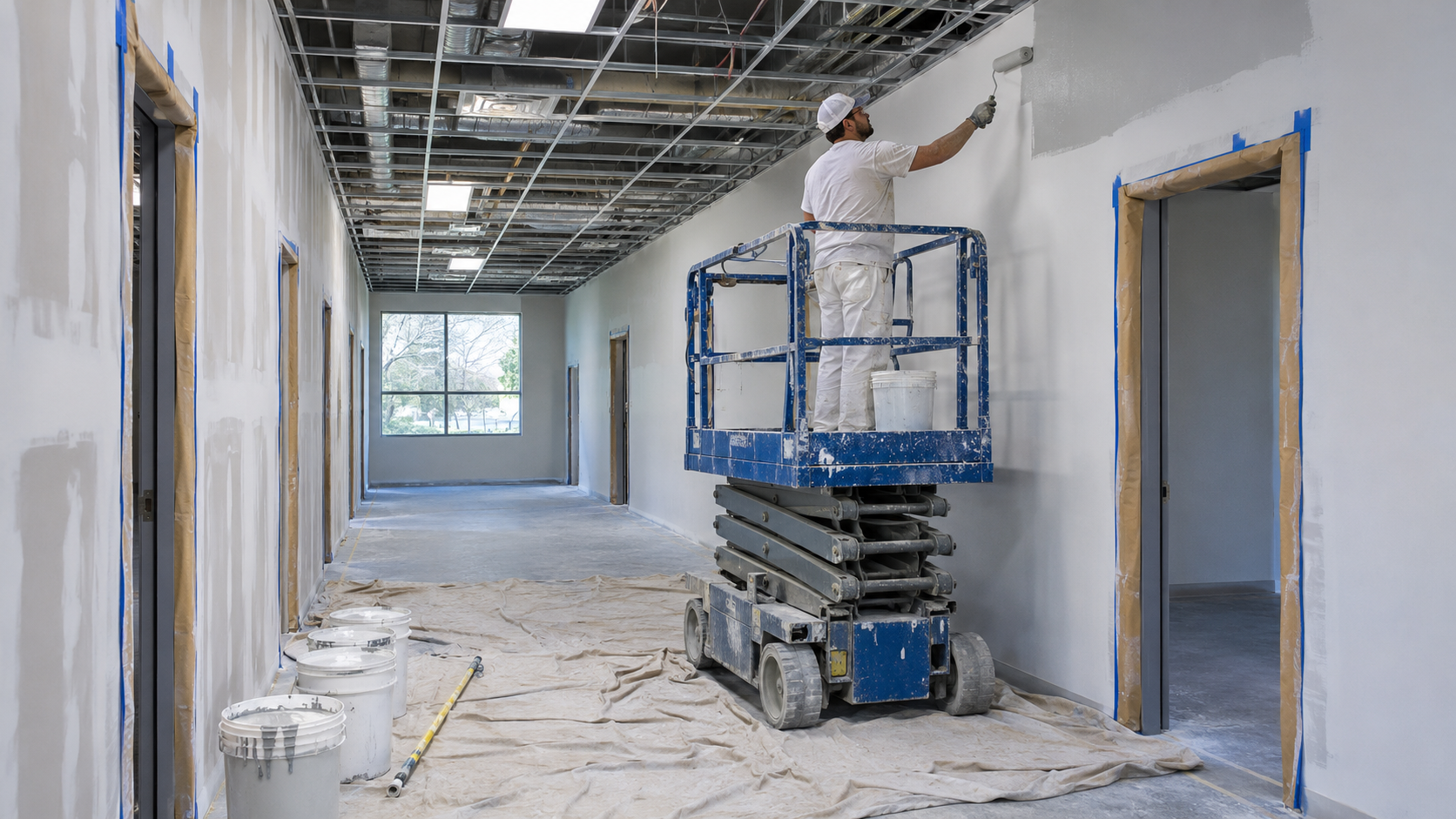




Commercial painting cost per square foot is the number every estimator reaches for first, and it is also the number most likely to lose you money. Published guides put it anywhere from about $1.00 to $6.00. Both ends of that range come from real projects. The difference is what each source counted. This article shows you how the rate gets built, so you can check your own number instead of copying someone else's.
We publish this on BuzzBID's website, and we sell takeoff and estimating software. The arithmetic below works the same whether you use our software, a competitor's, or a spreadsheet.
Published November 10, 2026. Pricing sources and manufacturer coverage rates checked November 2026.
What Published Sources Say Commercial Painting Costs Per Square Foot
Published ranges for commercial painting cluster between $1.50 and $6.00 per square foot, and they disagree with each other by a factor of seven at the extremes.
| Source | Interior | Exterior |
|---|---|---|
| HomeGuide | $2.00 to $6.00 per paintable square foot | Same range |
| Housecall Pro | $2.00 to $6.00 | $1.50 to $4.00 |
| Moorhouse Coating | $1.50 to $4.00 | $2.00 to $5.00 |
| Painters Inc (Chicago) | $1.08 | $0.82 |
One of these is not like the others. The Chicago figure sits below every other published number by half. It is also the only one that shows its arithmetic. That is the clue worth following.
Why Do the Published Ranges Disagree So Much?
The ranges disagree because they measure different things. Three differences account for most of the gap.
- Surface area versus floor area. Some sources price against paintable surface. Others price against building square footage. These are different numbers, and the ratio between them changes with every building.
- Direct cost versus selling price. A contractor quoting $1.08 reports what the work costs to put in place. A guide quoting $4.00 reports what an owner pays, with overhead, profit, mobilization and risk loaded in.
- Scope. Walls only, walls plus ceilings, or walls plus ceilings plus trim and doors all carry different rates. Specialty coatings move the number again.
None of these sources is lying. They answer different questions. Your bid answers a fourth question, and no published range can answer it for you.
What Is the Difference Between Paintable Square Feet and Floor Square Feet?
Paintable square feet measures the surface that receives coating. Floor square feet measures the building. The two rarely match, and nothing fixes the ratio between them.
Take a 10,000 square foot warehouse that measures 100 feet by 100 feet with a 20 foot clear height. The perimeter runs 400 linear feet. Multiply by the wall height and you get 8,000 square feet of wall. Deduct roughly 10 percent for dock doors and openings and you are left with about 7,200 square feet of paintable surface. That building's paintable area comes in below its floor area.
Now take a 3,500 square foot office suite with 9 foot ceilings and heavy interior partitioning. Count both faces of every partition along with the perimeter and you can pass 10,000 square feet of wall. That building's paintable area runs roughly three times its floor area.
Two jobs, two opposite ratios. An estimator who applies a published per square foot rate to building square footage will underbid one and overbid the other. Measure the surfaces.
How Many Square Feet Does a Gallon of Paint Cover?
A gallon covers between roughly 134 and 400 square feet per coat, and the coating system sets the number. Manufacturer data sheets state this directly. Sherwin-Williams lists its Pro Industrial Pre-Catalyzed Waterbased Epoxy at a recommended spreading rate of 400 square feet per gallon per coat. The same manufacturer lists its Pre-Catalyzed Waterbased Urethane at 134 to 267 square feet per gallon, because that product goes on at 6 to 12 wet mils instead of 4. You can read both figures in the published product data sheets.
Three things pull your real coverage below the printed rate:
- Surface texture. Smooth drywall drinks far less than split-face block or rough CMU. Porous masonry can cut coverage in half.
- Color change. Deep colors over light substrates often need a third coat, which adds 50 percent to material.
- Application method. Spray lays down faster but loses material to overspray. Brush and roll waste less and take longer.
Pull the spreading rate from the specified product's data sheet for every bid. Guessing at coverage is the single largest unforced error in painting material cost.
Build the Number: A 10,000 Square Foot Warehouse
Here is the full build-up on the warehouse above, with every assumption visible. Change any assumption and the answer changes with it, which is the point.
Quantity. 7,200 square feet of paintable wall. Two coats means 14,400 square feet of applied coating.
Material. At 400 square feet per gallon you need 36 gallons. At 200 square feet per gallon, which rough block will force, you need 72 gallons. Commercial paint commonly runs $50 to $75 per gallon. Call it $60. That puts material between $2,160 and $4,320, or $0.30 to $0.60 per paintable square foot.
Labor, brush and roll. A painter covers roughly 150 to 200 square feet per hour with a roller. Across 14,400 square feet of application that works out to 72 to 96 hours. At a loaded rate of $60 to $100 per hour, labor runs $4,320 to $9,600, or $0.60 to $1.33 per paintable square foot.
Direct cost. Add the two and you get $0.90 to $1.93 per square foot.
Spray changes this. Most crews spray open warehouse wall rather than roll it, and airless spray runs several times faster than a roller on uninterrupted surface. A sprayed version of this same job carries lower labor hours and higher material loss to overspray, so the two halves of the build-up move in opposite directions. Masking and back-rolling pull some of that speed back. Run your own production rates for the method you will actually use, and keep separate rates for sprayed open wall and rolled cut-in work on the same job.
Look at where the rolled number lands. The build-up produces a figure close to the Chicago contractor's $1.08, and well under the $2 to $6 that most published guides report. The gap between them is not paint. It is surface preparation, access equipment, mobilization, supervision, overhead and profit. Those belong in your bid. They just do not belong inside your base production rate, because every one of them moves independently of square footage.
What the Per Square Foot Rate Leaves Out
Five cost drivers sit outside the base rate, and each one can move a bid more than the paint does.
- Surface preparation. Washing, patching, sanding, priming and sealing stains. Condition drives this, so walk the building.
- Height and access. Work above about 10 feet needs lifts or staging. Lift rental, delivery, operator time and the slower production that comes with repositioning all stack up.
- Occupied space. Night and weekend work carries premium labor. Protecting furniture, equipment and finished floors costs hours nobody measures on the plan.
- Sequencing. Painting after other trades means touch-up. Painting before them means damage. Either way the schedule costs you.
- Coating system. Epoxies, urethanes and specialty industrial coatings carry higher material cost, slower production and tighter application windows.
This is where painting takeoff software changes the work. BuzzBID Advanced combines takeoff with assembly-based estimating in one application, so measured quantities carry into the estimate without a spreadsheet handoff. You can set labor production per area rather than across the whole bid, include overtime or additional support labor where the schedule demands it, and account for project duration through general conditions. When a finish schedule changes, you adjust the affected quantities instead of rebuilding the bid.
Does Exterior Commercial Painting Cost More Than Interior?
Published sources split on this, and the honest answer is that it depends on the building. Two of the four sources in the table above report exterior below interior. One reports it above. One reports the same range for both.
The reason is that exterior and interior each carry costs the other does not.
- Exterior work runs faster per square foot. Open elevations spray well, with few cut-ins and almost no protection of finishes inside the space.
- Exterior work carries harder costs elsewhere. Weather windows, lifts or swing staging, washing and preparing weathered substrate, and coatings rated for UV and moisture all add money.
- Substrate swings material hard. Tilt-up concrete, CMU and stucco absorb far more coating than finished drywall, which can double the material side of an exterior bid.
Price each elevation and each interior area on its own assumptions. A single blended per square foot rate across both will be wrong in one direction or the other.
How Much Should I Charge Per Square Foot for Commercial Painting?
Charge your own direct cost plus your own markup, and check the result against published ranges rather than starting from them. The sequence runs in this order:
- Measure paintable surface by finish type. Keep walls, ceilings, trim and specialty surfaces as separate quantities.
- Pull coverage from the specified product's data sheet and apply your real coat count.
- Apply your own production rates from completed jobs, separated by application method and adjusted for height, access and occupancy.
- Add prep, equipment, protection and general conditions as their own line items.
- Apply overhead and profit on the total.
- Divide by paintable square feet and compare. If your rate sits far outside $1.50 to $6.00, find out why before you submit.
That last step is the useful one. The published ranges work as a sanity check on a number you built. They fail as a substitute for building it. For a full walkthrough of the bid itself, read our guide on estimating a commercial painting job. If you also bid the substrate underneath the finish, see commercial drywall pricing per square foot.
What BuzzBID Advanced Costs
BuzzBID Advanced is $250 a month or $1,750 a year. We publish that price, and every customer pays the same. Software updates, technical support and unlimited training come with it, and there is no long‑term contract. BuzzBID Advanced won the 2025 AWCI Excellence in Construction Innovation Award.
Most commercial takeoff and estimating software still moves through a sales call and a custom quote. You can compare our price before you talk to anyone.
See the Painting Estimating Workflow
Bring a representative plan and finish schedule to a demonstration. Walk through how your team would organize the takeoff, build the assemblies and price a commercial painting bid, using your own production assumptions. Contact BuzzBID to set it up.