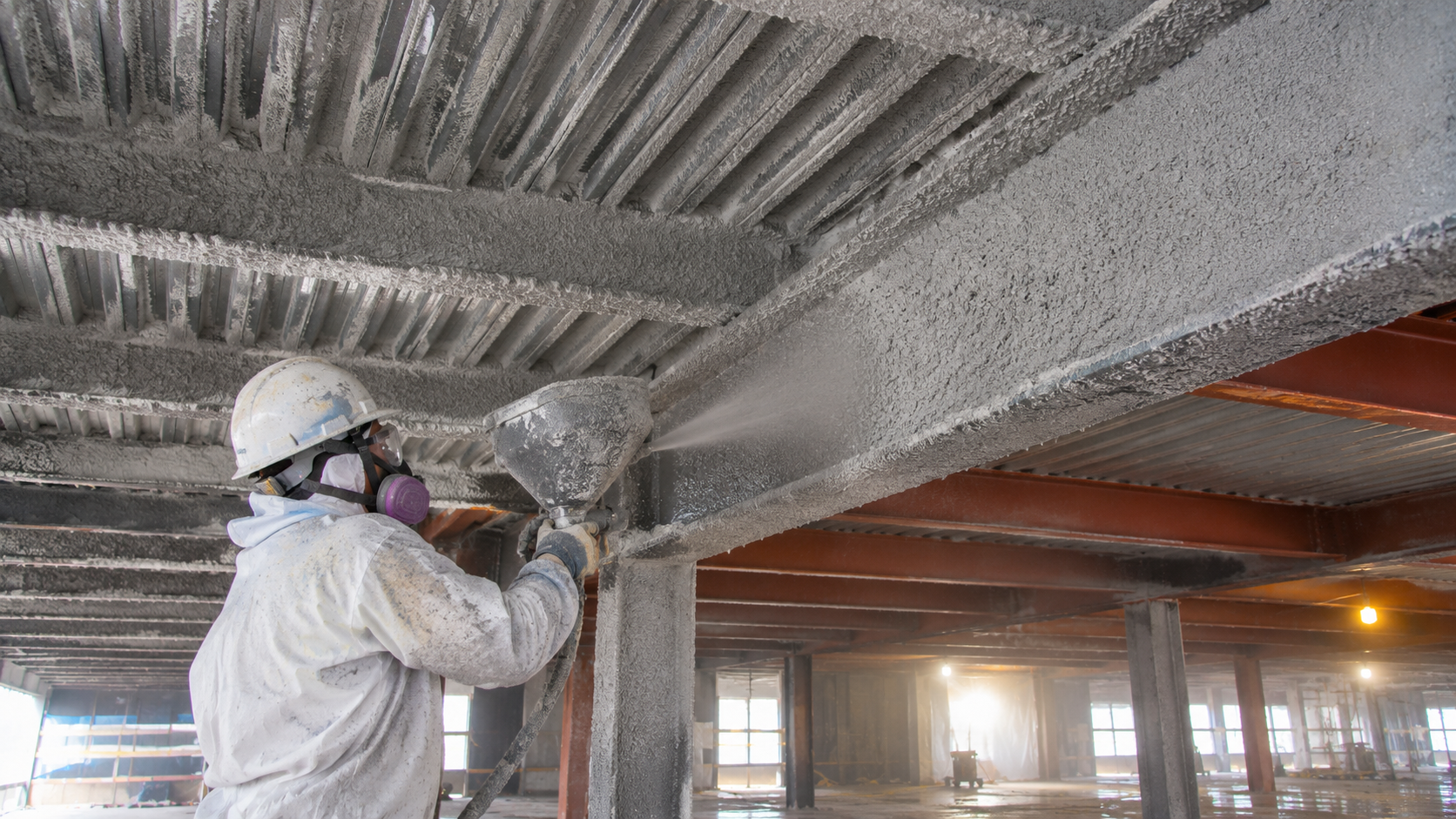




Quick answer: Published online guides currently place installed spray-applied fire-resistive material (SFRM) in a broad range of roughly $3 to $20 or more per square foot of protected steel surface. That range is a screening benchmark, not a bid price. The required material, listed design, fire-resistance rating, steel shape, thickness, density, access, testing, schedule, labor, and included scope can change the result substantially.
Reviewed November 13, 2026.
What Does Spray Fireproofing Cost per Square Foot?
There is no single national SFRM rate that applies to every project. Current online sources illustrate the spread:
| Published source | Reported benchmark | Important limitation |
|---|---|---|
| Bahl Fireproofing | Reports ranges that vary by SFRM density category, including approximately $5 to $20+ per square foot | A contractor-published guide. Geography, project type, thickness, access, and included work may differ from your project. |
| Blaze Estimating | Reports about $3 to $7 per square foot installed | An estimating-service benchmark, not an audited national price index. |
| Projul | Reports about $2 to $6 per square foot installed for SFRM | A general construction guide. The page does not establish one scope or design basis for every project. |
These sources were checked on November 13, 2026. They can help an estimator question an unusually high or low completed estimate, but they do not establish what a contractor should charge. Confirm whether any comparison uses protected steel surface, building floor area, or another measurement basis, and whether the number includes labor, equipment, testing, protection, patching, overhead, and profit.
The safest summary is: published SFRM cost benchmarks are broad because the scope behind each square foot is different. Build the project estimate first, then calculate the square-foot result.
Why SFRM Thickness Changes the Cost
The National Fireproofing Contractors Association describes SFRMs as aggregate-based products with cementitious binders applied to structural steel. Its product overview identifies applications ranging from approximately 1/4 inch to 3 7/8 inches across the product category. That is a category-wide range, not permission to select any thickness for a project.
The required thickness must come from the applicable listed fire-resistance design and project requirements. It can depend on the product, hourly rating, member type, steel size, exposure condition, and the weight-to-heated-perimeter relationship commonly expressed as W/D or A/P. UL Solutions explains that listed designs and applicable adjustment equations govern SFRM thickness for protected steel elements.
Do not infer a required thickness from a national cost article. Review the approved construction documents, specified product, listed design, manufacturer instructions, and any permitted adjustment method. Our separate guide explains the W/D ratio in fireproofing and why it affects thickness.
What Is a Board Foot of Fireproofing?
A board foot is a volume equal to one square foot at one inch thick, or 144 cubic inches. When protected surface area is already measured in square feet and thickness is expressed in inches, the conversion is:
Board feet = protected surface area in square feet × thickness in inches
- 1,000 square feet at 1 inch = 1,000 board feet.
- 1,000 square feet at 1.5 inches = 1,500 board feet.
- 1,000 square feet at 2 inches = 2,000 board feet.
Do not divide that square-foot-times-thickness result by 12. One board foot is one-twelfth of a cubic foot, but the conversion above already uses square feet and inches. Dividing again would convert the volume incorrectly. A simple check is that one square foot at one inch thick must equal one board foot.
Board feet are an estimating quantity, not the final purchase quantity. The specified product's current published yield, package size, installation method, permitted application conditions, and the contractor's documented allowance determine the number of bags or other shipping units.
How to Calculate SFRM Material Quantity
Use a traceable sequence rather than a generic bag-per-square-foot rule:
- Identify the included members and deck conditions. Separate beams, columns, joists, deck, attachments, flute fill, and other required conditions.
- Measure protected surface. Calculate the heated or developed perimeter applicable to each member and multiply by protected length. Keep flat deck quantities separate from wrapped-member quantities.
- Assign the listed design and required thickness. Confirm the product, hourly rating, member condition, and any authorized adjustment.
- Calculate board feet. Multiply each protected surface quantity by its required thickness in inches.
- Convert board feet using current manufacturer data. Use the specified product's published yield or coverage information and follow its instructions.
- Apply the contractor's documented allowance. Base waste, rebound, overspray, and repair allowances on the product, application, geometry, project conditions, and suitable company history. Do not apply the same loss twice.
- Round to purchasable units. Price current supplier quotes and package quantities rather than an old web price.
NFCA states that SFRM application should follow both the listed system and the manufacturer's installation instructions. The estimator should not substitute an assumed density, thickness, yield, substrate condition, or application method for those requirements.
Worked Example: Board Feet Without a Borrowed Bag Yield
The following example demonstrates the arithmetic only. It is not a product recommendation, production standard, waste factor, supplier quote, or project price.
- Measured protected surface: Assume 20,000 square feet across the members included in one estimating condition.
- Required thickness: Assume the applicable listed design and approved documents require 1.25 inches for that condition.
- Theoretical volume: 20,000 × 1.25 = 25,000 board feet.
- Purchase quantity: Divide 25,000 board feet by the specified product's current published yield per package, then apply the contractor's supportable allowance and round to available shipping units.
- Material cost: Multiply the purchase quantity by a current supplier quote and add applicable freight, tax, storage, handling, and related costs under the company's accounting method.
If another condition requires 2 inches on the same 20,000 square feet, its theoretical volume is 40,000 board feet. That illustrates why thickness matters, but it does not mean every other project cost doubles. Labor production, access, mobilization, protection, testing, supervision, and other costs must be estimated separately.
What Drives Spray Fireproofing Cost Beyond Material?
- Member geometry and scope: small shapes, attachments, joists, trusses, edges, and congested conditions may require more handling and detail than open repetitive members.
- Density and product selection: NFCA groups products into standard, medium, and high-density categories. Use the specified product and listed design rather than choosing a category from price alone.
- Access and sequencing: lifts, scaffolding, repeated repositioning, occupied areas, phased releases, and interference from other trades affect production.
- Protection, containment, and cleanup: adjacent work, finished surfaces, equipment, and overspray controls create project-specific labor and material.
- Substrate and preparation: compatibility, primer conditions, bonding agents, temperature, ventilation, and surface condition must be reviewed against the listing and manufacturer instructions.
- Flute fill and special details: deck flutes, attachments, lath, reinforcing, and transition conditions can create quantities that are easy to miss when everything is blended into one rate.
- Testing, inspection, and repair: project requirements may include thickness, density, and bond-strength testing, documentation, and corrective work.
- Labor burden, equipment, and indirect cost: wages alone are not the contractor's loaded labor cost. Include the company's applicable labor burden, equipment, supervision, project conditions, and documented overhead and profit method.
How Much Does Fireproofing Cost for a Commercial Building?
Building floor area is not a reliable substitute for protected steel surface. Two buildings with the same floor area may contain different structural systems, member sizes, ratings, densities, exposure conditions, deck scopes, and access constraints.
Build a commercial fireproofing estimate in this order:
- Review the fireproofing specification, life-safety drawings, structural documents, schedules, and bid instructions.
- Identify every included system, member type, rating zone, deck condition, attachment, and exclusion.
- Measure protected surface by condition and member type.
- Assign the applicable listed design, product, density, and required thickness.
- Calculate board feet and package quantities using current manufacturer information.
- Build labor from comparable completed work and define what each production rate includes.
- Add equipment, access, protection, cleanup, testing, supervision, schedule impacts, and other project costs.
- Apply the company's approved overhead and profit method and review the proposal language.
- Calculate the resulting price per protected square foot as a reasonableness check.
Keep cementitious SFRM and intumescent systems separate. Their material calculations, surface preparation, application, finish expectations, and pricing can differ substantially. Read cementitious versus intumescent fireproofing estimating for that distinction.
How BuzzBID FireShield Supports Fireproofing Estimates
BuzzBID FireShield combines structural-member takeoff, assembly-based estimating, and fireproofing-specific calculations and reports. BuzzBID states that FireShield includes structural-member recognition, UL Fire Test integration, heated-perimeter, board-foot, bag-count, and flute-fill calculations, plus As Estimated and Optimized spray reports.
Software does not select the correct listed design, product, thickness, density, coverage, production rate, scope, or contract position for the estimator. Users remain responsible for reviewing approved documents, current listings, manufacturer instructions, quantities, rates, conditions, reports, and proposal language.
BuzzBID currently lists FireShield at $300 per month or $2,450 per year, with software updates, technical support, and unlimited training included. Pricing and plan details can change, so review the current BuzzBID pricing page before making a purchase decision. For other products, see our fact-checked guide to the best fireproofing estimating software.
Spray Fireproofing Cost per Square Foot FAQs
What is the average spray fireproofing cost per square foot?
Current online guides publish broad installed benchmarks from roughly $3 to $20 or more per square foot of protected steel surface. The sources are not a single audited price index, and their scopes differ. Use the range only to check a completed project-specific estimate.
How do you calculate board feet of SFRM?
When area is in square feet and thickness is in inches, multiply protected surface area by thickness. One square foot at one inch thick equals one board foot. Then use the specified product's current published yield to convert board feet to purchasable packages.
How many square feet does a bag of fireproofing cover?
There is no universal answer. Coverage depends on the specified product's published yield, required thickness, density, application conditions, geometry, and the contractor's supportable allowance. Use current manufacturer information and do not derive package yield from an assumed density alone.
Does doubling SFRM thickness double the project cost?
Doubling thickness doubles the theoretical board-foot volume on the same protected surface. It does not automatically double the total project price because labor, access, mobilization, testing, protection, supervision, and other costs do not all scale in the same way.
Is intumescent fireproofing included in SFRM cost ranges?
It should be evaluated separately. SFRM and intumescent systems use different materials, thickness rules, preparation, application, and finish requirements. A broad fireproofing range that mixes them may be misleading unless the systems and included scope are identified.
The Bottom Line
A spray fireproofing cost per square foot is useful only after the estimator defines the surface, product, design, rating, thickness, density, access, and included scope. Calculate the protected area, convert it to board feet, use current manufacturer and supplier information, build labor and project conditions separately, and then use published benchmarks as a reasonableness check.
To review that workflow using a representative structural set and your specified assemblies, contact BuzzBID for a FireShield demonstration. For broader bid-risk practices, read How to Bid Construction Jobs Without Sacrificing Profit.