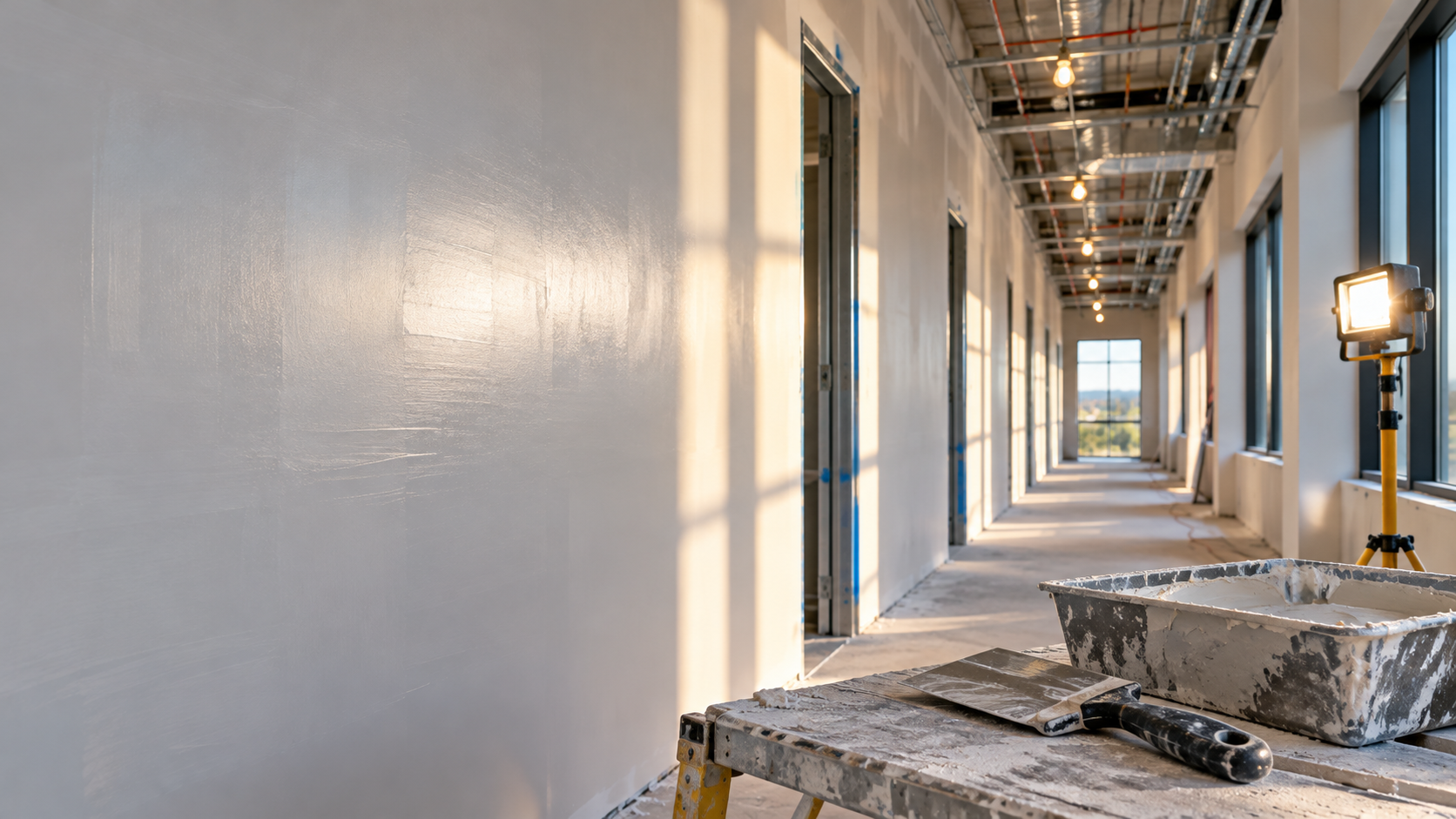




Quick Answer: A Level 4 drywall finish covers the joints, angles, fasteners, and accessories with joint compound and leaves the rest of the board face untouched. A Level 5 finish adds a thin skim coat of joint compound over the entire surface. The Gypsum Association recommends Level 4 for flat paints and Level 5 for sheen or gloss paints and critical lighting. For estimators, Level 5 adds a full-surface labor and material line, so price it separately.
The difference between a level 4 vs level 5 drywall finish comes down to one step: the skim coat. Level 4 finishes the joints and fasteners. Level 5 does everything Level 4 does, then covers the entire wall or ceiling with a thin coat of joint compound so the surface looks uniform under paint and light.
That one step changes a commercial drywall estimate more than most estimators expect. This guide explains what the Gypsum Association standard requires for each level, how to spot Level 5 in a spec, and how to price the difference so it never comes out of your margin.
What Is the Difference Between a Level 4 and Level 5 Drywall Finish?
The difference is that Level 5 adds a skim coat over the whole surface, while Level 4 treats only the joints, angles, fasteners, and accessories. The Gypsum Association defines both levels in GA-214, its standard for recommended levels of gypsum board finish. You can read the key points in the GA-214 quick reference guide.
| Level 4 | Level 5 | |
|---|---|---|
| Joint treatment | Tape embedded in joint compound, with additional coats over joints, angles, fasteners, and accessories | Everything in Level 4 |
| Surface treatment | None | "A thin skim coat of joint compound" over the entire surface |
| Typical paint | Flat paints | Non-flat paints, such as sheen or gloss |
| Lighting | Normal lighting | Recommended where "critical lighting conditions occur" |
| Main limit | "Not recommended where non-flat or dark/deep tone paints are applied" | Highest cost and longest finishing time |
GA-214 calls Level 5 the most effective way to get a uniform surface and reduce the chance of joints and fasteners showing through the paint. GA-214 also does not recommend unbacked vinyl wallcoverings over Level 4.
When Do You Need a Level 5 Drywall Finish?
You need a Level 5 drywall finish when the paint or the lighting would show the difference between the joints and the paper face. GA-214 points to three common triggers:
- Non-flat paints: Eggshell, satin, semi-gloss, and gloss paints show texture differences that flat paint hides.
- Dark or deep tone paints: GA-214 does not recommend Level 4 under these colors.
- Critical lighting: Light that rakes across a wall at a low angle, such as from windows, wall washers, or long corridors, highlights every joint.
On commercial jobs, Level 5 often shows up in lobbies, corridors with grazing light, conference rooms, and other high-visibility spaces. Back-of-house areas usually stay at Level 4 or lower. The specification and the finish schedule decide it, so never assume.
How Do You Know If a Spec Calls for Level 5?
You know a spec calls for Level 5 when the gypsum board section, the finish schedule, or a drawing note names it, so check all three. Most commercial projects place gypsum board in MasterFormat Section 09 29 00, and the finishing requirements usually appear in Part 3 (Execution) of that section.
Watch for these red flags as you read:
- "Level 5 where indicated" or "Level 5 at areas noted": Find every area the drawings mark, and measure each one.
- A finish schedule with gloss or semi-gloss paint: If the paint calls for sheen and the drywall spec says Level 4, flag the conflict in a question to the general contractor before bid day.
- Mock-up requirements: GA-214 states that for Levels 3, 4, and 5, "jobsite mock-up(s) shall be used to determine acceptance of the finish." A mock-up takes labor, material, and time, so price it.
- Who does the skim coat: Some bid packages put the Level 5 surface treatment in the drywall scope, and others leave it unclear between drywall and painting. Confirm it in writing.
The worst Level 5 mistake is a vague scope. "Level 5 where shown" turns into a fight if you priced 2,000 square feet and the architect expects 6,000.
How Much More Does a Level 5 Finish Cost?
A Level 5 finish costs more because it adds a full-surface skim coat, plus the drying, sanding, and inspection time that come with it. The exact difference depends on your crew, your market, and the job conditions, so build it from your own numbers instead of a rule of thumb.
Here is how to price it:
- Measure Level 5 areas separately. Take off Level 5 walls and ceilings in square feet, apart from your Level 4 areas.
- Price the skim coat by area, not by joint. Joint treatment follows the linear feet of joints, but the skim coat covers every square foot of the surface.
- Use your own production rate. Pull hours and square feet from past Level 5 jobs to get square feet per hour for the skim coat and the extra sanding.
- Add material from the data sheet. Use the joint compound manufacturer's coverage figures for a skim coat, plus a waste allowance from your own history.
- Add time for drying and inspection. Level 5 work often needs extra trips, temporary lighting, and punch-list time.
- Price the mock-up. Carry it as its own line so the owner sees it.
Our commercial drywall pricing guide shows how finish level fits into the full cost per square foot, along with framing, board, and labor.
How BuzzBID Prices Level 4 and Level 5 Areas
The hardest part of pricing Level 5 is keeping it separate from Level 4 without losing track of either. BuzzBID's commercial drywall estimating software handles that in one place.
- Fast takeoff by area: ClickONCE™ computer vision takes off wall partitions and acoustical ceilings, up to 500% faster, estimator verified.
- Assembly-based estimating: BuzzBID Advanced applies material and labor costs to your takeoff, so you can carry Level 4 and Level 5 areas as separate items with their own production rates.
- Labor adjustments: Labor production modifiers, overtime labor estimating, and additional support labor cover the extra time a Level 5 finish takes.
- Clear proposals: The bid proposal generator puts your scope, including Level 5 areas, in front of the general contractor in writing.
BuzzBID Advanced costs $250 a month or $1,750 a year, with no long-term contract, and it won AWCI's 2025 Excellence in Construction Innovation Award. The team behind On-Screen Takeoff and Quick Bid built it for commercial specialty contractors like drywall and acoustical ceiling estimators. To see how it compares to other tools, read our list of the best drywall estimating software for commercial contractors.
Level 4 vs. Level 5 Drywall Finish FAQ
Is Level 4 enough for commercial walls?
Yes, Level 4 is enough for most commercial walls that get flat paint under normal lighting. GA-214 typically recommends Level 4 for smooth walls decorated with flat paints. Move to Level 5 when the spec calls for sheen or gloss paint, dark colors, or critical lighting.
Do you need a mock-up for a Level 5 finish?
Yes, GA-214 states that jobsite mock-ups "shall be used to determine acceptance of the finish" for Levels 3, 4, and 5, and it says the design professional should specify the procedure unless it is waived in writing. Price the mock-up as its own line item.
Does a Level 5 finish need primer?
Yes, GA-214 says the final decoration specification should include a primer applied before painting, for every finish level. Check whether the primer belongs to the drywall or painting scope. Our guide on how to estimate commercial painting jobs covers how painters price primer and finish coats.
Price Every Finish Level Right
The level 4 vs level 5 drywall finish decision changes how much compound, labor, and time your bid needs. Read the spec closely, measure Level 5 areas on their own, and price the skim coat from your own production. Compare BuzzBID's published plans or contact the BuzzBID team to see a drywall estimate with Level 4 and Level 5 areas built on your own plans.